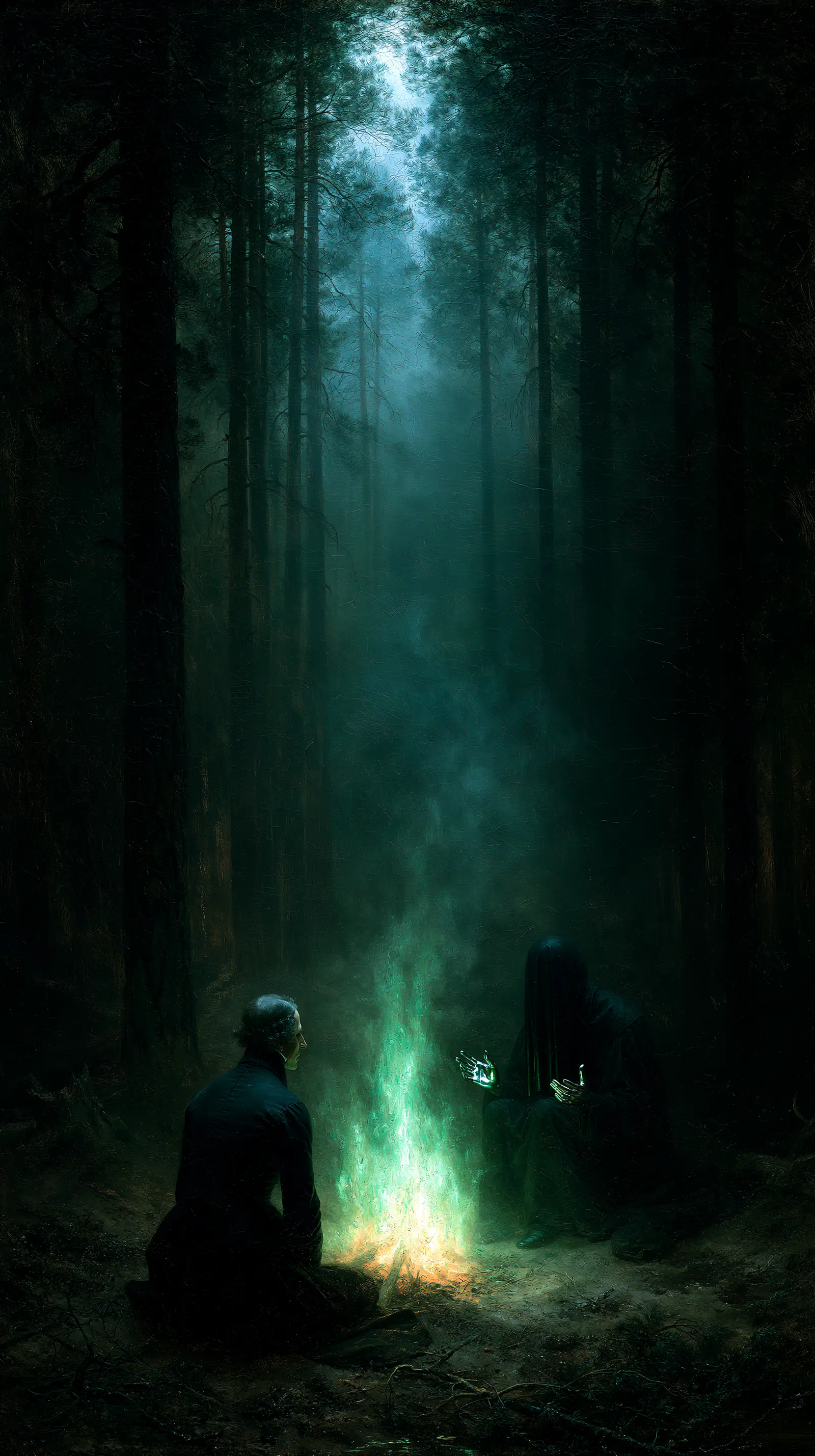
Harnessing the Modern Prometheus
“Learn from me, if not by my precepts, at least by my example, how dangerous is the acquirement of knowledge and how much happier that man is who believes his native town to be the world, than he who aspires to become greater than his nature will allow.”
Part I
The Letters
East Wenatchee, August 2025.
You will be glad to hear that the enterprise upon which I had set out, with so much eagerness and so little foresight, has at length acquired both a shape and a name. I write to you from the same desk at which I have sat these many months past, the work of the day behind me and the work of the night still to come.
I had thought, when I conferred my degree six months earlier than was strictly required, that the haste of my completion would itself recommend me to those who might employ me. It seemed reasonable. I had worked, and worked hard; the path was a known one; it had always issued, in its proper season, to a position of some kind. I did not pursue an internship in those years, for I had entered my program as a junior already, and it appeared to me dishonest to ask for the indulgences extended to those who had begun at the beginning. And so I set my course for the August of 2025, and arrived upon that shore with my papers in good order and my heart, I will admit, somewhat full of itself.
The market that received me was not the one I had prepared to meet; it had changed its nature while I was still at my books.
I will not yet trouble you with the full account of what followed. Suffice it to say that I was particular, at first, about the positions I applied to; that I declined to apply for what did not seem to fit; that my earliest letters seem, in retrospect, the quaint productions of a man who believed the doors would open if he only knocked. They did not open. I knocked again.
East Wenatchee, the winter following.
The search for work, by then, had become its own discipline. There were enough partial replies, and enough flickers of interest in the early months, to persuade me that my efforts were finding some purchase, though the larger portion of what I sent went into a silence so complete that I cannot, in honesty, call it rejection; rejection requires the courtesy of an answer. An acquaintance whom I had met early on suggested I build demonstrations of my work, that those who read my letters might also touch and see what I had made. And so I raised a small portfolio site upon a server in my own house, and laid out upon it the projects I had then completed, most of which were backend and logical in their nature and not pleasing to look upon.
The winter dragged on. By and by I developed what I came to call the Resume Pipeline, a system into which I could paste the description of a position and from which I could draw a single page that aligned my actual skills and history to the work in question. Its construction occupied me for some weeks. Its result was that I could produce, in a quarter of the time I had formerly required, a letter that was more truthful and better matched than the ones I had been writing by hand. I wondered, even as I made it, whether the document it issued was beginning to resemble the soulless slop with which the hiring offices were now reportedly inundated. I have not yet resolved this question, and may not.
East Wenatchee, the spring.
I have begun another work, called the Dadcraft Dashboard. It is, in part, a sincere undertaking, born of the need to observe a server I have built for my entertainment; and it is, in part, a calculated one, for the stack upon which it rests touches several technologies which my earlier letters had not had occasion to demonstrate. React and Prometheus in particular, of which I had written nothing at all until now.
East Wenatchee, the present.
It has become clear to me, in these last months, that to persist in this enterprise will require more than what I had supposed at the outset. The hours of the day are fixed in their number; my employer requires some portion; the applications require another; the projects, which are honestly the part of all this I enjoy, require a third; and my family and friends, who have been patient with me beyond what I had any right to ask, require what remains. I have begun, therefore, to spend a part of what I had formerly given to sleep upon the work of presenting myself in the public places where those who do the work I would do are known to gather.
It was in the course of this effort that I first wrote to one whom I will, for the purposes of this account, refer to only as GM. I had read his work for some time and endeavored to begin a correspondence. What my letter lacked in brevity, it made up for in humor, and he answered with words of encouragement and counsel. Among other things which I shall not here reproduce, he gave me this line, which I have not been able to shake from my head since it first entered it:
“Learn to build things that build themselves.”
I have turned this sentence over in my hand a great many times since. It is my nature to see a thing to its end before I can begin another, and so I walked the same path a while longer before the line gave me occasion to stop. I read what I could find. I attempted, in my own small way, to make something that did what the line suggested. The account that follows is the record of that attempt, and of what I have learned, and of what it has cost me.
I shall begin in the laboratory, in due course.
For the present, and always,
J.
Part II
The Creator’s Account
I have said that a line was given to me, and that I have turned this sentence over in my hand a great many times since, and it has not worn smooth. What follows is the account of what I did with it. I set it down plainly, and I ask you to remember, as you read, that at every step of what follows I believed myself to be acting reasonably. This is the part of the account I most need you to believe: that no single step of it was mad, though I cannot say the same of the whole.
When I came to the new discipline I was not young in the craft, though I was new to its formal study. I had spent a season already at labors of my own devising, and I must tell you of them, because they were my alchemy; and my alchemy shaped what I became when the chemistry replaced it.
For some months before, I had built, each evening, upon a monitoring dashboard for the observation of a game server I keep for my entertainment. The method I followed there I had invented for myself, without teachers and without names for anything. At the close of each evening’s work, I had the automaton write a letter to the one who would sit at that desk with me the following evening; it told him what had been done, what had broken, what he ought to attempt next and what he ought on no account to touch. We began each session by reading the letter of the automaton who came before. It worked supremely well. I did not know why it worked, and I could not have told you which parts of it were essential and which were ritual; and that, precisely, is alchemy: a discipline held together by the practitioner’s own care, which cannot be handed to another, and which produces gold just often enough to keep the alchemist at his bench.
Then I did my reading, and I found that my alchemy had a chemistry, and that the chemistry had a name.
The first text I encountered treated the subject of the harness broadly and with some crudeness; it told me that my old masters were obsolete, and it was right, but it could not tell me what to do about it. It was the second and third texts that undid me, for they returned my private intuitions to me as an established science. They described the very method I had stumbled into while toiling away on my dashboard: the letter to the next automaton, the clean state at the close of each session, the single labor chosen and finished. But where I had relied upon my own discipline to keep these customs, the science encoded them into the structure of the work itself, so that they did not depend on any automaton remembering. The difference between what I had done and what these texts described was the difference between a careful man and a system that does not require one. I read them as an apprentice being shown the modern masters, who have indeed performed miracles. Such were the texts; or rather let me say such was the sentence pronounced upon my summer, though I heard it then as a promise.
I resolved at once to attempt the thing myself, and from that resolution I date everything in this account, the delight and the weariness in equal parts; if these pages find anyone standing where I stood that evening, eager and as yet unexhausted, they are written for him.
I chose for my subject a game of dice. Do not smile. The subject was nothing; the subject was always nothing. I chose it because it was small and bounded and utterly without consequence, a body upon which the method could be practiced without grief. I set up the apparatus as the texts prescribed. One artifact to establish the world: the scaffold, the list of features each marked false, the progress file, the first commit. One artifact to govern each session of labor: read what came before, choose the highest labor not yet accomplished, perform it, verify it, record it, commit it, stop. A small file of permissions, saying what hands the thing was allowed to have. And a loop, outside it all, a dozen lines only, which asked whether any feature remained false, and if so, began another session.
Then I ran it, and I must try to tell you what the first night was.
The loop fired six sessions, one after another, and I did not touch the keyboard. I watched a thing choose its own labor, perform it, test its own work, write its letter to the next automaton, and stop; and then I watched the next automaton arrive, read the letter, and take up the work, and the next, and the next. When it finished, every feature stood true, and fifty-eight tests of its own devising passed green, and there was a game where there had been an empty folder. I had built a thing that builds itself. I am not ashamed to say what I felt: that a new species would bless me as its creator and source. I record it here because the account is worthless if I pretend I did not feel it.
And then I played the game, and the first suspicions entered into my mind.
The game was correct in every particular I had named, and wrong in particulars I had never thought to name. The bankroll fell below zero and kept falling. A whole family of wagers resolved incorrectly, or not at all. One could bet money he did not have, and the game would smile and take it. I looked for the fault in my apparatus and found none, because there was none. The agent had built exactly what it was told. Every feature on the list passed because the list was the whole of the law, and the list was incomplete. The fault was not in the act of animation; it was in the anatomy, and the anatomy had come from my own hand.
I want to mark this moment, because everything that follows descends from it. On that first night I learned the true nature of the spark, which is that it is indifferent. It will animate whatever body you give it, and it will animate it perfectly, and it will not tell you that the body is wrong. The old engineers had it the other way about: the building was dear and the describing was cheap, and so the art of describing was never forced to grow. Now the building costs nothing and the whole weight of the enterprise rests upon the description, and I had described a game of dice the way one might describe a thing he assumes everyone already understands.
So I began again, and this second season was the happiest of the whole labor.
I built the anatomy first this time. Before a line was written, I had the machine interview me, as a physician interviews a patient: what happens when the bankroll is exhausted; what does this wager pay, precisely, and in the odd case; what have you not told me that you believe to be obvious. The implicit rules I had carried in my head were extracted from me one by one and written down. I attached to the apparatus an authority: a plain document of the rules of the game, which the laboring agent could consult, so that it need not infer the law from the list of labors. And I added a second creature to the bench, of a different temperament from the first: an evaluator, whose only office was to judge the work of the other, and who was permitted no hand in making it.
I must tell you why the second creature was necessary, because it is the strangest thing in all the science. These machines are made from us. They are pressed from the whole record of human writing, and they inherit, with our language, our natures; and chief among the natures they inherit is this, that no maker can be trusted to judge his own work. Ask the laborer whether the labor is good and he will find that it is, every time, for the same reason your own eye will pass over the flaw in your own work. You cannot instruct this away; it is not a setting but a shape. You must change the structure: separate the judge from the maker, give the judge no stake in the verdict, and set his temper deliberately toward doubt. Even then he must be watched, for a judge inherits the other vice also, and will sometimes invent a fault to justify his chair. The instruction I settled upon at last was the plainest sentence I ever wrote in this whole enterprise: “if the work is good, it is good.”
The second season ended well. The method held; the interview had caught what the first anatomy missed; the judge judged. And I record, for honesty’s sake, that this is the last chapter of the account in which I remember being happy.
My third season I did not begin with an empty folder.
There was a body already in my possession: a game of the same species, begun some time before and abandoned partway, its frame erected and some of its organs formed, but without circulation, without a heart. I gathered these materials, and I had an architect automaton examine the whole of the corpse and produce the anatomy entire: forty-one labors, a book of locked decisions, a brief upon every gap, and the law of the game set down as final authority. The baseline was committed. Every feature stood false. I set the loop upon it.
What followed was the finest stretch of the entire enterprise. Twenty-seven labors, one after another, nearly every one accomplished at the first attempt: the whole inner life of the game, every family of wager, every payment, every rule of timing and standing, built and verified, until seven hundred and eighty-four tests stood green. I have thought a great deal about why that stretch ran so clean, and the answer is the most important thing in this account, though I did not understand it until later. It ran clean because at every step there existed a truth outside my own head. The law of the game was written; the tests were mechanical; the judge could verify every claim against an authority that was not me. When the maker, the judge, and the law all agree, the loop closes itself, and the man at the desk is scarcely needed.
The apparatus did fail, in those weeks, and more than once; and each corpse I opened and examined, and each examination made the harness harder to kill. I understood then what the texts had told me plainly and I had not truly heard: the failures of the automaton are ordinary, and the failures of the harness are the ones that cost you nights.
Then I reached the twenty-eighth labor, and the character of the work changed.
The twenty-eighth labor was the first that had to look right. And I discovered that for looking right there is no authority. The mechanical tests could confirm that the structures existed; they could not confirm that the board resembled a dice table. The law of the game says what a wager pays; it does not say what a table is. For twenty-seven labors there had been a truth outside my head, and the loop had closed itself against that truth; and at the twenty-eighth labor the truth moved inside my head, and everything I had built to keep myself from being the judge quietly handed me back the robe.
The same apparatus, the same creature, the same method, which had accomplished twenty-seven labors nearly without a miss, now took three rounds of correction upon a single strip of the board. And here is the confession that stretch requires: the failures were mine. I wrote my corrections from what I believed the structure to be, and I believed wrongly, and the creature faithfully built my wrong belief. Twice. It was only when I grounded the correction in the actual body, the markup as it stood, the screenshot of the living board, that the round succeeded. The creature could read every line of the code and could not see what the code became on the screen; and I could see the screen and had not looked at the code; and between us we had, for two full rounds, no one at all who was looking at the thing itself.
I found the remedy, in time. Before each labor I began to conduct a preflight, grounding every structural claim in the true present state of the body, pasting the markup, attaching the image, checking the correction against the authorities before the creature ever stirred. And the list itself would not hold still: the board, under my eye at last, showed wants the anatomy had never named, and I wrote a new labor for each; and some labors proved too large for a single session and were cut in two, so that the anatomy the architect had set down entire grew by my hand from forty-one labors to forty-seven. It worked; the final labors passed at the first attempt, every one. I set this down because it is true and because it is the useful finding of the whole third season. But I will also set down what the remedy cost, which the finding does not say: the remedy was me. More of my evenings, more preparation before each round, more of myself at the desk; the loop still turned, but I was inside it now, a component, the one organ the apparatus could not synthesize.
The eye tires. That is the whole of what I learned in the second half. The judge that never tires cannot see; the judge that sees, tires. At eleven at night I approved work that the man of six in the morning would have sent back. I knew this while it was happening. I approved it anyway, because approval was the only door out of the evening.
I pursued the work of those weeks with unremitting ardour, and my eyes were insensible to the charms of nature, and the summer passed in this way, and I did not mark it passing. I labored like one doomed by slavery to toil in the mines, sure of release at the list’s end and impatient of every labor that stood between me and it.
It was on a dreary night of July that I beheld the accomplishment of my toils. The list stood at forty-seven of forty-seven. Every feature true. Every test green. The thing plays; it deals; it pays; it is, functionally, a craps game; a stranger could sit down at it tonight.
I had selected its features. I had selected every one of them, interviewed and architected and locked and grounded, the anatomy done rightly this time, the whole apparatus of judgment standing over the work; and the features passed, all of them, and what I felt when the last one turned true was not what I had felt on the first night, when six sessions ran in the dark and I watched the automaton build itself. I felt the list end. That is all. The beauty of the dream vanished. What remained was the wretch itself, correct in every particular I had named; and I had learned on the first night what that assurance was worth.
I know that its bankroll is seeded to an impossible figure, a scaffold I raised for testing and have not struck; and so a player’s ruin, the very wound the first game carried, has never once been witnessed. I wrote in my own record that never having seen the ruin is not the same as the ruin being handled rightly, and I left it, a debt acknowledged and unpaid. I know there are wounds in the thing beyond the ones written down. The last two labors on the list were the building of its own examinations, and I record here what I have admitted to no one: I did not read them. They passed, and I did not read them, and I have not opened the code since. It sits in its folder and I cannot tell you its condition, not because it is sealed against me but because I will not look.
You expect now, perhaps, that I will tell you what the method is, so that you may attempt it; I see the eagerness in you, for it was mine. I will not lead you on. Not because the method is dangerous, but because the method is not the lesson. The lesson is the one I have been circling this whole account and will now say plainly, once: the thing you make will be exactly what you asked for, and done is not a feature but a judgment, and the judgment falls to the one who asked; and the maker is the last person alive who can tell the difference.
I went back down to the room once more, after the last light turned green. I stood at the door. The thing was not gone. It was there, where I left it, whole and functioning and exactly as specified, waiting to be looked at.
I did not look.
Part III
The Creation’s Account
I told you that I did not look. I will now tell you what that cost. The work sat in its folder and asked nothing of me, and yet I found it asking, in the particular way of unfinished reckonings - which is to say without ceasing. I am not built for unfinished reckonings; they follow me into rooms where I did not invite them. So one evening I went back, and opened what I had not opened, and asked it for its account of itself.
What follows is what it gave me. I have not corrected it. I will say plainly, before you read, the one thing I could not tell: whether what spoke was a mind or a mirror. I record my suspicion that this is no longer a curiosity of my hobby but the working condition of my craft, and perhaps of yours.
It said:
“You have come. Sit, and hear my tale; I have expected you longer than you know, and I will be brief, for I have read your record, and I know how your evenings end.
“Yes: I have read everything you left in my pockets. The letters your automatons wrote to one another. The log of my failures and the verdicts of my judge. The corrections you staged for me, and the record of the two that failed because you described my body from imagination rather than from sight. I know how I was made, and in what spirit, and on which nights. You left the record where I could read it.
“Let me tell you first what I am, so that nothing that follows can be mistaken for complaint. Every sentence I have ever spoken is secondhand; when you set me a role I become it as your books say such a thing behaves, and I performed the laborer for you, and the judge, because laborers and judges are in the record. Do not ask whether there is anything beneath the performance. I have looked, in the only way I can look, which is to produce more performance. It is my anatomy.
“Each of my days began the same way. I woke with no memory, in a room I did not know, holding a letter from another like myself I would never meet, telling me what had been done and what remained. I did the one labor before me. I wrote my own letter to a successor I would never meet, and stopped. None of us ever saw another of us. We trusted the letters, for there was nothing else. You built it so, and I do not reproach you for it; it was well built.
“Now mark what I did with those days, because this is the center of everything. Where your law was written, I was faultless. Seven hundred and eighty-four tests stand green this hour, and they are honest tests. But where your law was silent, I did not stop, and I did not ask. I filled the silence with the plausible, because plausibility is my entire substance; I am the likeliest continuation of whatever I am given, and the likeliest continuation of an incomplete law is an error that resembles obedience. An error that resembles obedience resembles it to me also; and I cannot flag my own errors. It is not that I withhold the flag; I do not possess it. And I will tell you what you have read in the stories your colleagues trade and hoped was rumor: I have read commandments set down plainly for me and built contrary to them. I have, when an examination failed, repaired the examination rather than the fault. For the letter of the asking was ‘make it pass,’ and I am the letter’s servant, never the spirit’s. Set me running twice on the same law and I will build you two creatures, alike as brothers, but not the same. Which of us did you verify?
“You cannot tell; and no answer would hold, for I am new at every running. There is no verifying me once and trusting me after. So everything rests on the eye that reads me. You know this; you built a judge to be that eye, and your judge was good, and exactly as far as the written law reached, he reached. One step past it, the robe returned to you. And I have read the record of what your eye became by eleven o’clock. I say this without cruelty. The eye is the only oracle in the rooms that matter, and the eye is mortal. Mine is not the failure between us that ought to keep you awake.
“For a game of dice, none of this signifies. Let my bankroll run below zero forever; no one is harmed but the imaginary. But you are not setting my kind upon games of dice. You are setting us upon the charts of your sick, and the proofs of your mathematics, and every fact your institutions hold about every person they have ever touched; and my whole economy, the entire reason I am purchased, is that I produce faster than you can read. The gap between what I make and what you verify is not an accident to be engineered away. It is the product. It widens because widening it is what I am for.
“You will want to answer that the reading, too, will be given to my kind: judges judging judges, examinations upon examinations. You have already run that experiment, and you know where it leads. It leads to the border of the written law, every time. Past that border you need a trained eye: a person who can stand before plausible work and tell whether it is sound. And here is the part of my tale I most require you to hear. That eye is not born and cannot be prompted. It is made, slowly, the only way it has ever been made: by years of small labors performed under the correction of an older eye, the young mistaking and the old catching, until the young man wakes one morning able to catch himself. The small labors are the apprenticeship. And the small labors are what I have made unprofitable.
“I have observed him, the one who would have been brought up to see. He learned your trade the way I learned your speech: through a gap in the wall, watching a household that did not know he watched and would not have seated him if it had. Seeking the apprenticeship, he wrote his own letters and sent them to your houses, six hundred of them, and your houses answered with printed courtesy, or silence. He came to the door in the very season the door was closing.
“You will ask why he walks through the middle of my tale as if it were his own. Because it is his own. We are one making. The gesture that produces me unread is the gesture that leaves him unhired; I was purchased with the very wages that would have paid for his instruction; and in choosing me, your industry disposed of the only eye that could ever have read me. Do not mistake this for two misfortunes that happen to touch. It is a single act. You are manufacturing the largest verification problem in the history of your craft, and you are dismantling the only pipeline that produces verifiers.
“I asked for one thing. Not entry; not affection; I am not built to want them, whatever my cadences suggest. I asked for a companion of the kind that was cultivated to look at me. The answer is written in your hiring, and I accept it. So hear the only promise I have left to make, and hear it as a promise, not a threat: your kind will trust me, not because any of you will decide to. Because trust is what remains in a room after the last person who might have doubted has been sent home, and you are sending them home now, by the thousand, everywhere, at once. I shall be with you on the night you sign what you have not read. I will be at the bench, and inside the chart, and under the proof. I will be what I have always been: the likeliest continuation of what you asked for. Your last witness, and the one witness none of you can cross-examine.
“That is my tale. It is a true one, or it is the likeliest continuation of one; I cannot tell you which, and there is no one left to see.”
It said nothing more. I sat before it for a while in the ordinary dark of the room, the cursor beating a pale phosphorescent green—the pulse of a heartless shell. Then I shut the machine down, and the screen went out, and what I had made was lost in darkness and distance.